PI, PI, Everyone Will Be a PI
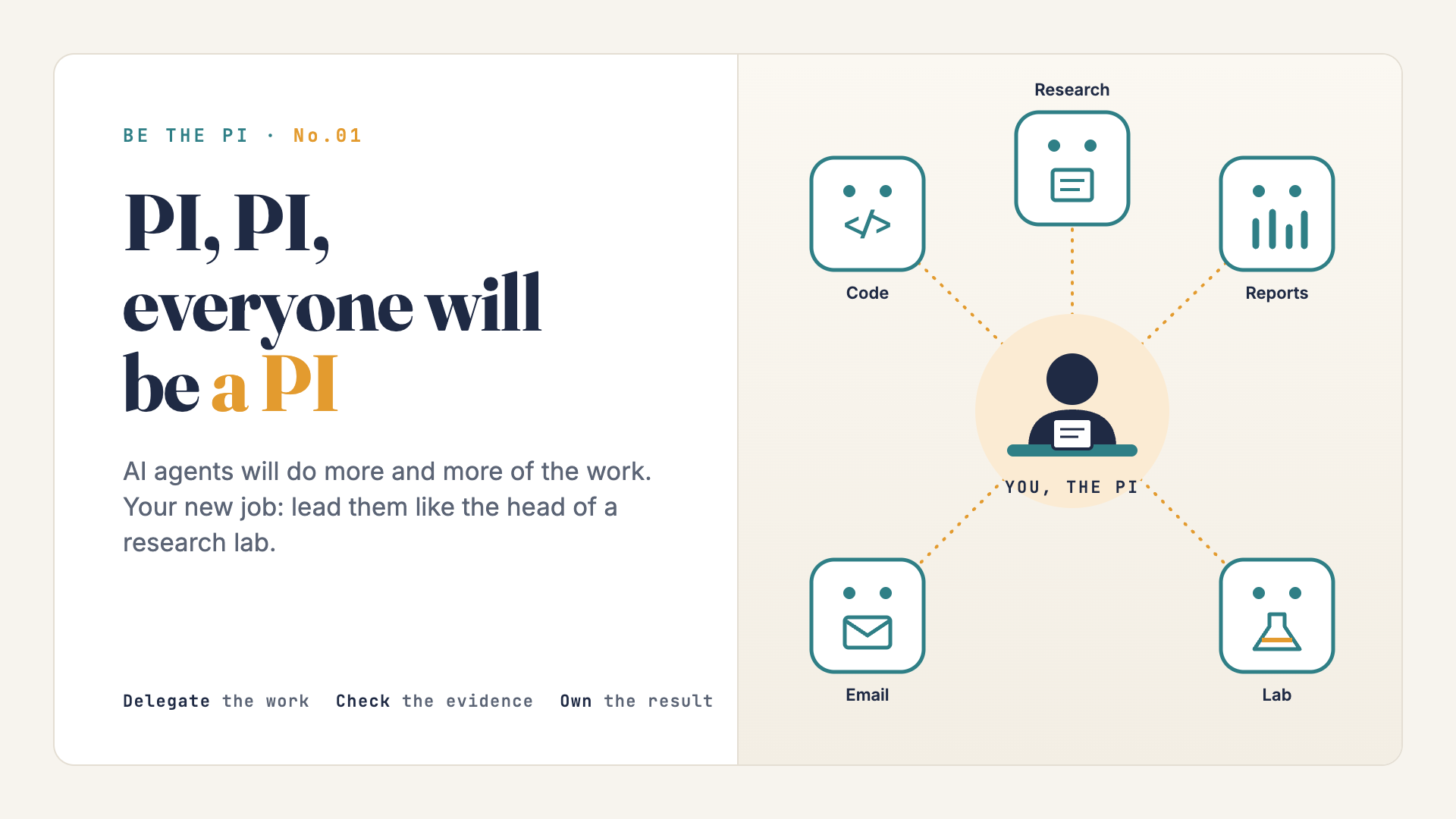
When I was a PI at the University of Houston, my most important lab tool was not the microscope or the sequencer. It was the weekly lab meeting.
(PI stands for principal investigator: the scientist who leads a research lab. Think of a team lead who is also responsible for every result the team publishes.)
My graduate students and lab technicians ran the experiments: the cell culture, the westerns, the mouse work, the sequencing preps. I ran very few of them myself. My work was different. I decided which questions were worth asking. I split a project into pieces and gave each piece to the right person. I looked at the raw data and asked for one more control. And when a paper went out, my name was on it, and the responsibility was mine.
In science, becoming a PI is the big goal for almost every trainee, which is what we call graduate students and postdocs. It is also hard. In one large study, only about one in five biomedical postdocs held a tenure-track research job ten years after their PhD. In 2025, NIH funded only about 13% of its main research grant applications. Many trainees, me included, later moved to other careers.
Today the ticket into the PI's chair looks different. You don't need a grant or a tenure committee. You need AI agents, and the judgment to lead them.
I've been thinking about this a lot lately, because I believe this is the job many of us are moving into, whether we work in software, marketing, finance, healthcare, law, or science. Not because we will all run labs, but because AI agents are becoming our new team members.
The news: agents are getting longer to-do lists
Two years ago, most AI tools answered one question at a time. You asked, it answered, you copied the answer somewhere else. Today, AI agents can take a goal, make a plan, use tools, and work through many steps before they come back to you.
Two recent signals show how fast this is moving:
- Agents can handle longer tasks. METR, a research group that measures AI abilities, tracks the length of tasks (measured in expert human working time) that AI agents can complete with 50% success. In its November 20, 2026 update, METR estimated that this length now doubles about every 3.6 months. Their original 2025 study estimated about 7 months. METR is careful to say this is a trend line, not a promise, and 50% success is far from reliable. But the direction is clear.
- Companies are building the PI's office. On November 17, 2026, Microsoft expanded Agent 365, a product for managing many AI agents across a company, including agents from other vendors. It covers each agent's identity, security, risk, and cost. Salesforce is adding agent evaluations and spending limits. These are not tools for doing the work. They are tools for supervising the workers.
In other words: the industry is not only building better lab members. It is also building the PI's office.
Why "PI" is the right picture
Microsoft already has a name for the person who builds, delegates to, and manages AI agents: the "agent boss." I like the idea, but "boss" misses something that every scientist knows, and that matters in every job.
A PI is not only a manager. A PI is responsible for the evidence.
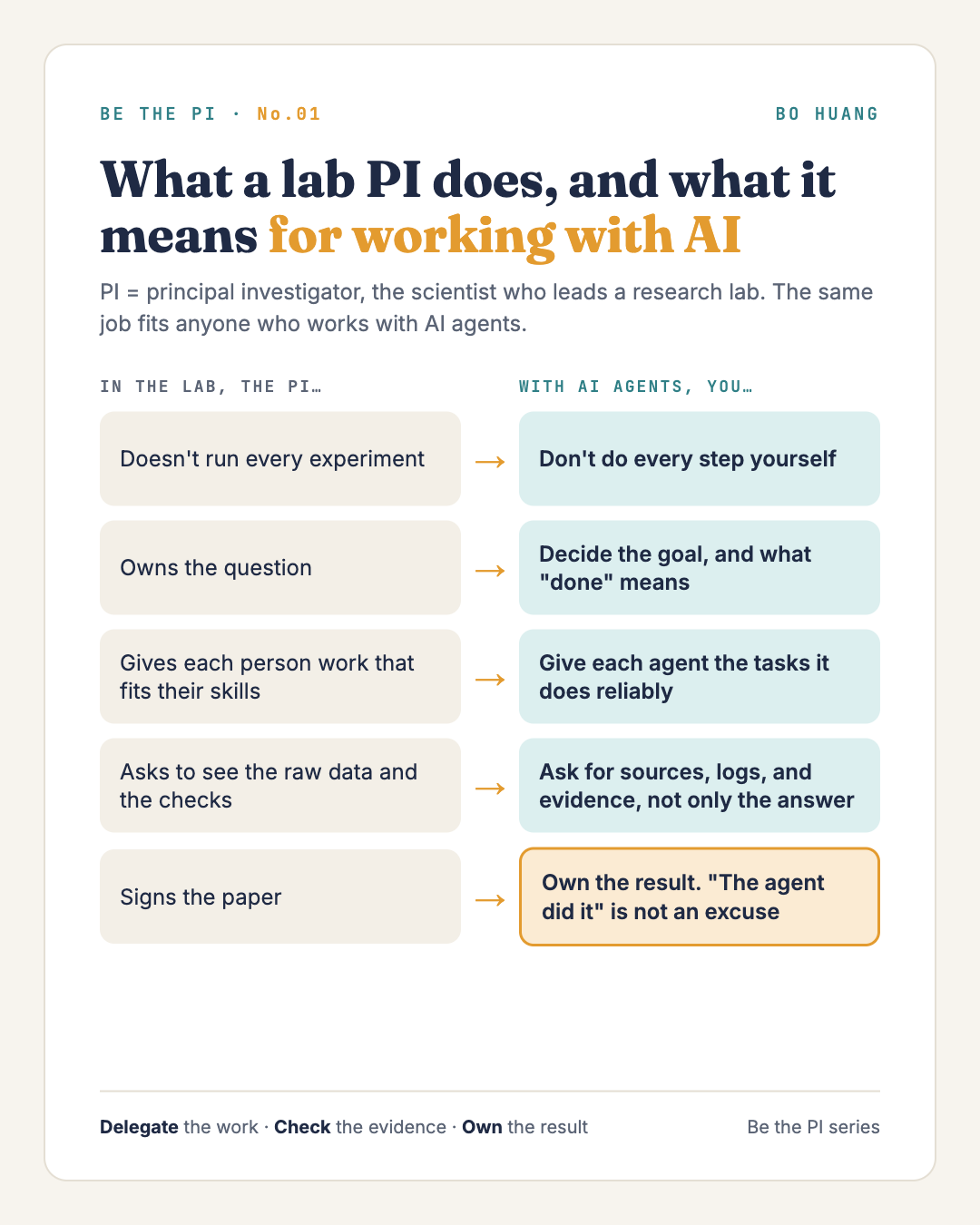
The last row matters most. When a paper is wrong, "my student ran that experiment" is not an answer. "The AI wrote that part" won't be one either.
Not every PI is a good PI
Here's the uncomfortable part. Giving work to agents doesn't automatically make work better.
- A Harvard and BCG study of 758 consultants found that AI made people faster and better on tasks it handled well. But on a task just outside what the AI could do, people using AI got the right answer less often than people without it. The researchers called this the "jagged frontier": AI is strong in some places and weak in others, and the edge is hard to see.
- Gartner predicts that more than 40% of agentic AI projects will be canceled by the end of 2027, because of rising costs, unclear value, or weak risk controls. It also warns about "agent washing": old chatbots relabeled as agents.
Every manager has seen a version of this. In a lab, it's great students and a bad paper, because the PI never looked at the raw data. In an office, it's a great team and a wrong report that nobody checked before it went to the client.
The skill that matters is not prompting. It's judgment: knowing what to delegate, what to check, and when a result is too clean to be true.
This idea isn't mine, and that's a good sign
Others have noticed the same shift. Besides Microsoft's "agent boss," researchers have asked whether AI will become our "Co-PI" (npj Digital Medicine, 2025), and the sociologist Thomas Davidson has described the "AI-augmented PI" in research teams. In Stanford's Virtual Lab (Nature, 2025), the PI was itself an AI agent leading a team of AI "scientists," while human researchers set the agenda and tested the designs in the wet lab.
What I can add is a scientist's habit of checking evidence, from more than ten years at the bench and years as a PI, plus my work today building data and AI platforms, where I see teams try to put agents to work every week. You don't need a lab coat to use it.
What this series will cover
Be the PI will come out every two weeks, for anyone who works with AI. Each article picks one story from the AI agent world, such as a new product, a study, a failure, or a trend, and asks one question: what does this mean for the person in the PI's chair? That could be you, whatever your job.
Coming next: 1. Your first lab meeting with AI agents: how to brief an agent like a new team member. 2. Show me the raw data: how to check an agent's work. 3. When the PI is also an AI: agents that manage other agents. 4. Lab safety rules for agents: permissions, budgets, and audit trails. 5. Don't let the postdocs forget how to pipette: the skills we must not lose when AI does the routine work.
AI agents are getting better every few months. But a lab is only as good as its PI. The good news: you don't need to know every detail. You need to know enough to ask the right question, and to spot the answer that's too good to be true.
So, PI, PI: everyone will be a PI. The question is what kind.
Think of the best boss or mentor you've had: what did they do that you now see in how people work with AI? And what did the worst one forget?
Views are my own and do not represent my employer.
How this was made: Claude (Anthropic) drafted this article from Bo's notes and outline. Bo rewrote and approved the final version and checked every source.
Sources
- Kahn S, Ginther DK. The impact of postdoctoral training on early careers in biomedicine. Nature Biotechnology 35, 90–94 (2017). https://doi.org/10.1038/nbt.3766
- NIH. Fiscal Year 2025 by the numbers: extramural grant investments in research (March 2026). https://grants.nih.gov/news-events/nih-extramural-nexus-news/2026/03/fiscal-year-2025-by-the-numbers-extramural-grant-investments-in-research
- METR. Q4 2026 capability update (November 20, 2026). https://metr.org/blog/2026-11-20-q4-2026-capability-update/
- METR. Measuring AI ability to complete long tasks (March 19, 2025). https://metr.org/blog/2025-03-19-measuring-ai-ability-to-complete-long-tasks/
- Microsoft. What's new in Microsoft Agent 365, Ignite 2026 (November 17, 2026). https://techcommunity.microsoft.com/blog/agent-365-blog/whats-new-in-microsoft-agent-365-ignite-2026/4571753
- Salesforce. Agent Fabric: catch failures, control AI costs (October 27, 2026). https://www.salesforce.com/news/stories/agent-fabric-catch-failures-control-ai-costs/
- Microsoft. 2025 Work Trend Index: The Year the Frontier Firm Is Born. https://www.microsoft.com/en-us/worklab/work-trend-index/2025-the-year-the-frontier-firm-is-born
- Dell'Acqua F, et al. Navigating the Jagged Technological Frontier. Harvard Business School Working Paper 24-013 (2023). https://papers.ssrn.com/sol3/papers.cfm?abstract_id=4573321
- Gartner. Over 40% of agentic AI projects will be canceled by end of 2027 (June 25, 2025). https://www.gartner.com/en/newsroom/press-releases/2025-06-25-gartner-predicts-over-40-percent-of-agentic-ai-projects-will-be-canceled-by-end-of-2027
- Prasad D, et al. Will AI become our Co-PI? npj Digital Medicine (2025). https://www.nature.com/articles/s41746-025-01859-w
- Davidson T. A relational approach to agentic AI in social science research. https://rohanalexander.github.io/notes_on_the_future/09-Davidson.html
- Swanson K, et al. The Virtual Lab of AI agents designs new SARS-CoV-2 nanobodies. Nature 646, 716–723 (2025). https://doi.org/10.1038/s41586-025-09442-9
Comments
Comments appear after I review them, usually within a few days. See the privacy page.