Tokens: The Refined Fuel of Meaning in AI
In my last data article, I wrote about modeling data: tables, keys, and relationships. This one is about modeling meaning, which people call semantic modeling.
There are two ways to model meaning:
- Explicitly, by writing it down: knowledge graphs, ontologies, and taxonomies, where people define each term and how terms relate.
- Implicitly, by learning it from data. This is what modern AI does. Models learn meaning from huge amounts of text, stored as long lists of numbers called embeddings.
Today's generative AI relies almost entirely on the second way. To understand how it works, you need one concept: tokens.
What a token is
A token is the basic unit a model reads: a whole word, part of a word, or a symbol. When a large language model (LLM) is trained, nobody gives it rules for what each term means. It reads enormous sequences of tokens and learns meaning from context: which tokens appear together, and how they're used.
Research supports this view. Tang and colleagues (2023) found that LLMs reason mainly through these learned meanings, not through formal logic. So to understand how AI handles meaning, you have to understand how tokens are made, what they stand for, and how embeddings organize them.
(Researchers are also exploring "large concept models" that work with whole ideas instead of tokens, but those are still early experiments.)
Two other meanings of "token"
"Token" gets used in other ways, so it's worth being clear.
- Billing tokens. AI companies charge by the token. Kent Beck's essay "Tokens: The New Oil" is about tokens in this sense, as units you pay for.
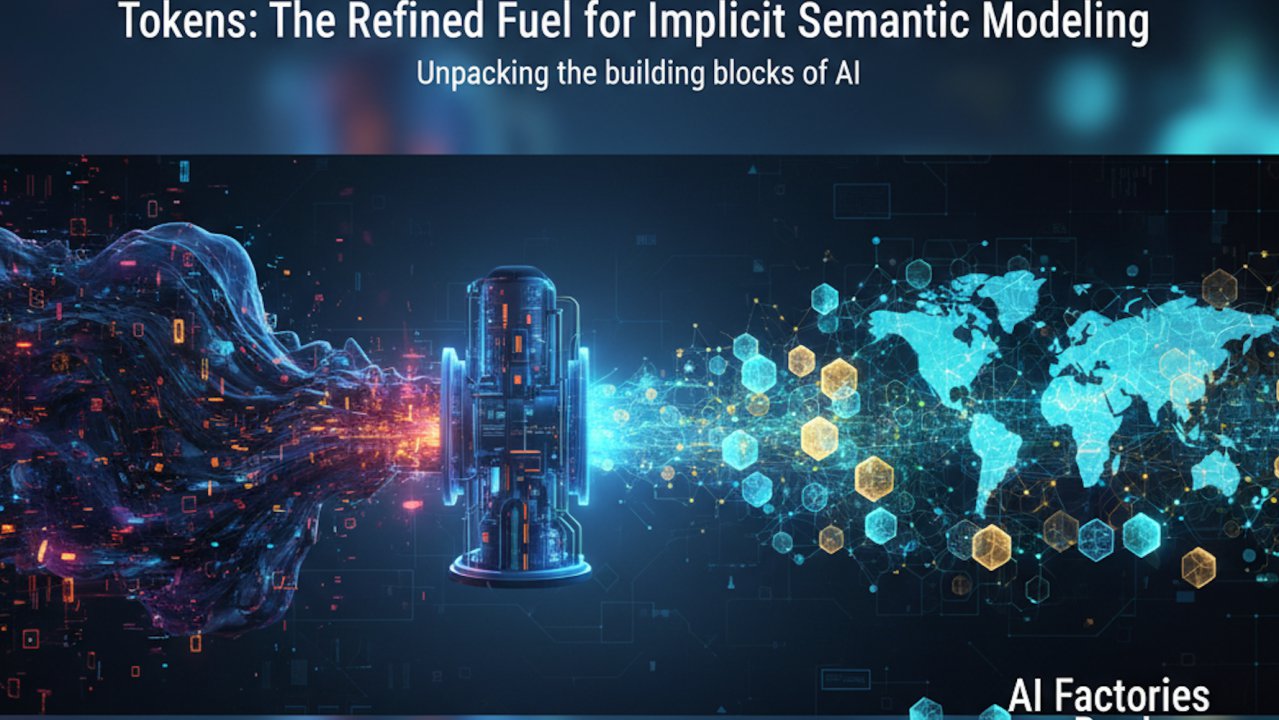
- Tokens as factory output. NVIDIA CEO Jensen Huang describes AI factories: computing centers that turn data and electricity into tokens, which then become text, images, protein designs, or robot actions. In his picture, data is the raw material and tokens are the product.
My focus is narrower: the tokens inside the model, which carry meaning. But Huang's big-picture view shows why tokens deserve attention.
Tokens aren't only text, either. Models that handle images, video, and sound cut those into tokens too: small image patches, video frames, and slices of audio. The better these tokens capture meaning, the more capable the model becomes. Whoever can produce high-quality tokens for specialized fields will have a real advantage.
How tokens are made, and where people matter
Cutting text into tokens, called tokenization, is mostly automatic and learned from data. But in specialized or high-stakes fields, human judgment still matters a lot:
- Choosing the right training text. A tokenizer trained only on general web text handles specialized terms poorly. Including legal, medical, or biotech text gives it a better vocabulary for that field.
- Adding key terms. Adding important terms to the vocabulary, such as COVID-19, BRCA1, or SARS-CoV-2, keeps them whole instead of breaking them into meaningless fragments.
- Setting the vocabulary. People decide how big the vocabulary should be and how words get split, balancing efficiency against precision.
- Checking quality. Someone has to check how often terms get split, how well the field's vocabulary is covered, and how rare words are handled, often by looking at examples by hand.
Here's an example from biology. A general-purpose tokenizer might sensibly split neuroinflammation into "neuro" and "inflammation." But it may break lipopolysaccharide or encephalomyelitis into pieces that carry no meaning at all, unless it has been adapted for biomedical text.
Where the opportunity is
Tokens aren't just a technical detail. They're also a business opportunity.
One promising area is tokenizers and embedding models tuned for specific fields, such as biotech, medicine, finance, or law, along with tools that check token quality and coverage. Companies in specialized and regulated industries would pay for that, because better tokens lead to better search, more accurate answers, and better classification.
In short: better tokens, better meaning, better AI.
If you work in a specialized field, has tokenization helped or hurt your AI work? I'd like to hear about it.
How this was made: Bo wrote and edited this article. Claude (Anthropic) helped check references, edit the English, and format it for the site. Bo reviewed every change and is responsible for the content.
References
- Tang, X., et al. (2023). Large Language Models are In-Context Semantic Reasoners rather than Symbolic Reasoners. arXiv:2305.14825.
- Beck, K. (2024). Tokens: The New Oil.
- Business Insider (2024). NVIDIA CEO Jensen Huang on every company becoming an "AI factory."
- NVIDIA Blog (2024). AI factories and the future of tokens.
- InformationWeek (2024). Interview with Jensen Huang on tokens and the generative AI workforce.
Comments
Comments appear after I review them, usually within a few days. See the privacy page.