How to Pass a Technical Certification Fast: Lessons from the Databricks Data Engineer Professional Exam
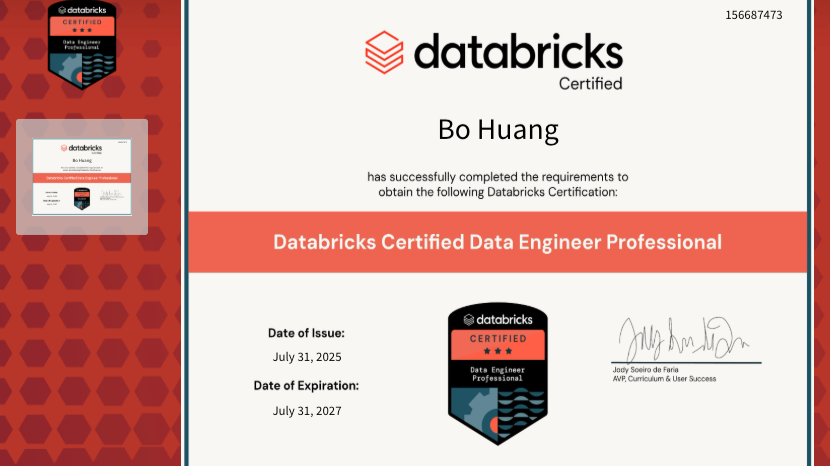
Written in August 2025. Exam formats and content change, so check the current official exam guide before you start.
Passing a technical certification quickly isn't about cramming. It's about preparing smart. This is the approach I've used for eight exams, along with what I learned from working through more than 1,000 practice questions. Most of my exams were Microsoft and Databricks certifications, but the same approach should work for AWS, Google Cloud, Snowflake, and others.
I'll use the Databricks Certified Data Engineer Professional exam as the example.
Step 1: Know the four types of questions
The first step is to understand what the exam is really testing. I sort the questions into four types:
| Question type | What it tests |
|---|---|
| 1. Core concepts | Data engineering ideas that apply on any platform |
| 2. Platform scenarios | How this particular platform carries out those ideas, such as Z-ordering, auto optimize, and watermarking |
| 3. Syntax and recall | Remembering Spark or PySpark syntax, functions, and API calls. Not hard, but time-consuming |
| 4. Careful-reading questions | Long or tricky wording: similar-sounding names, hidden assumptions, extra details |
1. Core concepts
These are the foundations of data engineering, true on any platform. Expect questions on:
- Partitioning and clustering: how they speed up or slow down queries.
- Indexing: Spark doesn't use traditional indexes, but Databricks gets a similar effect with Z-ordering, which lets queries skip files they don't need.
- Slowly changing dimensions (SCD): the difference between Types 1, 2, and 3, which decide whether a table keeps the history of a changing value.
- Join strategies: broadcast joins versus shuffle joins, and the trade-offs when data is spread across many machines.
- Batch versus streaming: processing data in scheduled chunks versus continuously, and when each makes sense.
- Performance tuning: memory, file sizes, caching, and Spark optimization.
2. Platform scenarios
This is where the exam gets specific. The questions ask how Databricks expects you to apply the core ideas in realistic situations:
- How partitioning and Z-ordering work for Delta Lake tables.
- Streaming with Auto Loader, watermarking (deciding how long to wait for late data), and handling changes in a table's structure.
- When to use
read.format("delta")versusreadStream.format("delta"), and what changes. - Notebooks, Spark SQL, Unity Catalog, and scheduling jobs and tasks.
- Error handling in production pipelines, such as late-arriving data or corrupted records.
3. Syntax and recall
Some questions check that you remember exact syntax and settings:
- API usage, such as the syntax of a Delta Lake
MERGEstatement or the parameters ofwithWatermark(). - Built-in functions, such as
current_timestamp()or window functions in streaming queries. - Command-line and REST API basics.
- Common error messages and what they mean.
At work you'd just look these up. Tools like ChatGPT, GitHub Copilot, and code completion in your editor fill in the details. In a timed exam you have none of them, so knowing the 10 to 20 most common snippets saves real time.
4. Careful-reading questions
I used to joke that these are reading tests in disguise. They check less what you know and more whether you can stay calm, read carefully, and reason through unclear wording:
- Misleading names.
spark.table("stream_sink")sounds like a streaming job, but it may simply be reading a Delta table. - Small clues in long text. A key detail, such as whether a table is append-only or whether schema enforcement is on, may sit in the middle of a long paragraph.
- Separating signal from noise. Some scenarios include details that don't matter, and you have to find the ones that do.
Microsoft exams often include hands-on lab tasks. Databricks relies more on text-heavy questions, so careful reading matters even more. As a non-native English speaker, I find this doubly hard, and a good reminder to slow down.
Step 2: Decide what "done" means
Before you start studying, ask yourself why you're taking the exam. There are usually two answers:
- Mastery. You want deep knowledge of the platform, and the certificate is a bonus.
- Pass fast. You need the credential soon, for a project or a job search.
This article is about the second goal.
Pass means aiming for the passing score, typically around 70%, not 100%. That's fine: certifications are usually designed so the passing score means "ready for the job."
Fast means making trade-offs. If one section would take too long to master before your exam date, it's OK to skip it for now, as long as the rest of your preparation gives you enough margin to pass.
Step 3: Prepare differently for each type
| Question type | How to prepare | Resources |
|---|---|---|
| 1. Core concepts | Aim for clear understanding. Draw diagrams, or explain partitioning, indexing, and SCDs out loud to yourself. Practice with examples. | Delta Lake documentation; Spark documentation on joins, partitioning, and caching; ChatGPT; explainer videos |
| 2. Platform scenarios | Practice in a real Databricks workspace. Use notebooks to test partitioning, streaming, and Delta optimizations. Know the difference between read() and readStream(). |
Databricks documentation and release notes; Databricks Academy courses, especially the labs; practice exams; the Databricks blog for real use cases |
| 3. Syntax and recall | Don't memorize everything. Focus on common patterns, such as using withWatermark() or MERGE with Delta, and make a cheat sheet. |
Spark API docs; common code snippets on GitHub; your own notebook of "flashcards" |
| 4. Careful reading | Read slowly and note the key facts. Don't jump at familiar keywords. Rule out clearly wrong options. Focus on the real context of each question. | Practice exams, to get used to the style; your own notes on mistakes you made in practice tests |
Step 4: On exam day
Use all the time. Many people fail not because they didn't know the material but because they rushed. Most of these exams give you about two hours. Don't submit early, even if you've finished a first pass. In the last 15 to 20 minutes your mind is often calmer, and you'll catch details you missed. Go back over the questions you flagged.
Watch for clues in other questions. One question's code example sometimes shows a function or setting you weren't sure about in another question. Notice repeated terms and settings: they can jog your memory or confirm a guess.
When you truly don't know, guess smartly.
- First rule out the clearly wrong options. There are usually one or two that don't make sense.
- Prefer answers that use the same wording as the official documentation.
- Be careful with absolute words like "always," "never," and "only," unless you're sure.
Final thoughts
Passing efficiently takes a smart approach, not only hard work. From my own experience, which is admittedly biased, I'd guess that test-taking skill, reasoning, and good preparation can account for as much as half of your result.
That doesn't make the real skills less important. They are what the exam is meant to measure, and they're what you'll use on the job.
Some context about me: my two weeks of part-time preparation for this exam didn't start from zero, and I wouldn't recommend that timeline to someone fresh out of a biology degree. I had been working in data and AI consulting and had used Databricks for several years. Even so, most projects only go deep into one part of the platform, so broad exam preparation still took focused effort.
Since writing my first line of Python as a biology PhD student, I've taken eight certifications and passed each one on the first try. I don't chase certificates. Real projects and learning by doing matter more. But each exam took a different preparation plan at a different stage of my career:
| Exam | Provider | My preparation time (with a full-time job) |
|---|---|---|
| Analyzing and Visualizing Data with Microsoft Power BI | Microsoft | 1 month |
| Perform Cloud Data Science with Azure Machine Learning | Microsoft | 3 months |
| Analyzing and Visualizing Data with Microsoft Excel | Microsoft | 2 weeks |
| Designing and Implementing an Azure AI Solution | Microsoft | 2 months |
| Microsoft Power Platform Fundamentals | Microsoft | 1 month |
| Implementing Analytics Solutions Using Microsoft Fabric | Microsoft | 1 month |
| Databricks Certified Generative AI Engineer Associate | Databricks | 1 month |
| Databricks Certified Data Engineer Professional | Databricks | 2 weeks |
What if you don't have that background? Then the plan looks different. I'd like to write that up next: study plans of two weeks, one month, and three months for working professionals, at one to two hours a day.
How this was made: Bo wrote and edited this article. Claude (Anthropic) helped check references, edit the English, and format it for the site. Bo reviewed every change and is responsible for the content.
Comments
Comments appear after I review them, usually within a few days. See the privacy page.