How ChatGPT Deep Research Helped Me Pass the DP-700 Exam
In an earlier article, ChatGPT as a Personal Tutor, I listed a few ways ChatGPT can help you prepare for a technical certification exam:
- Explaining each exam topic in plain language.
- Making study aids such as flashcards and summaries.
- Practicing with sample questions and reviewing why each answer is right or wrong.
- Learning test-taking tactics, like ruling out options and flagging questions to revisit.
This time I'll go one step further, with how I prepared for DP-700, Microsoft's certification exam for data engineers working in Microsoft Fabric. Three things helped most:
- Focusing on the main exam areas.
- A study plan ranked by priority, for someone with only 20 to 40 hours to study.
- Catching up on what had changed in Fabric over the previous two years.
All three came from one ChatGPT feature: Deep Research, which OpenAI released in 2025. It's an agent: instead of answering from memory, it searches the web, reads sources, and writes a report.
Deep Research as a study planner
Deep Research can collect, organize, and summarize study resources. More importantly, it can fit them to your background and schedule. That's what makes ChatGPT a truly personal tutor.
Here's how I used it. The point isn't the exact plan, but how I worked with it.
The prompt I gave it:
You are a professional data engineering coach and experienced data and AI exam taker. My background: 10+ years of data engineering experience with SQL, ETL, and medallion architecture. I've used Fabric before but have been less hands-on recently. Based on the DP-700 exam guide, create a 30-hour study plan focusing on (1) core exam topics and (2) new Fabric features from the past two years. Assume I have limited time, so focus only on high-impact areas to reach at least 70% on the exam.
Before starting, it asked me three questions, much like a good tutor would:
- Was I already familiar with Power BI or DAX?
- Should the guide cover only Microsoft Fabric, or general Azure data engineering topics too?
- Did I want a schedule broken into hours per day, or a ranked list of topics to use flexibly?
Once I answered, it ran 47 searches, used 14 sources, and finished in about six minutes. The result covered the main exam areas, new Fabric features from the past one to two years, and a ranked study plan with resources for each topic.
Here's a small part of the output:
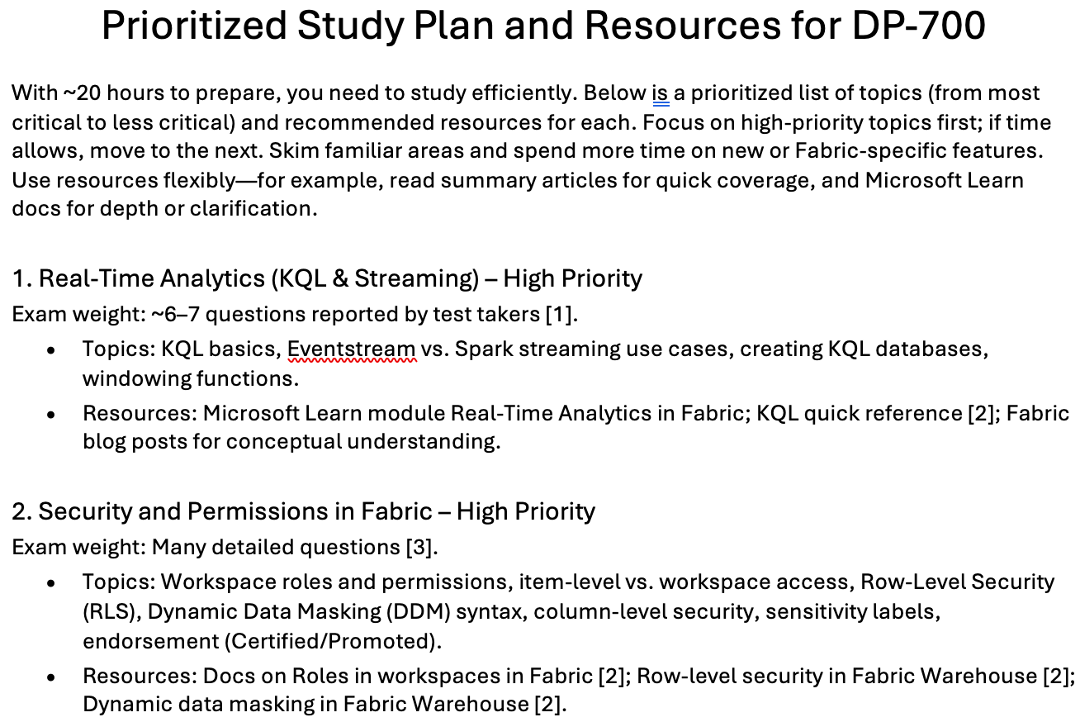
(AI-generated content from my own prompt, reviewed and edited by me.)
You can also see each step of its work and every source it used:
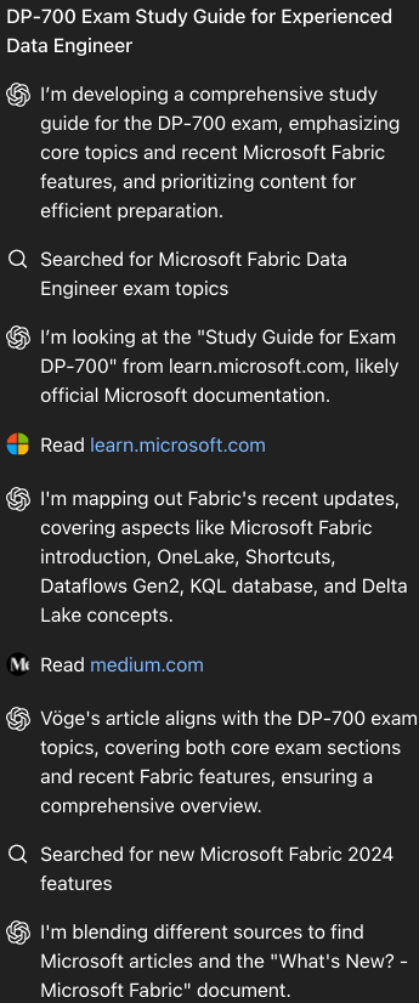
Through a researcher's eyes
With my PhD and years of biomedical research, I pay close attention to how information is gathered and summarized. I was genuinely impressed. Deep Research did something very like the literature reviews I used to write in academia: search widely, read the sources, and pull out what matters.
Its visible reasoning, citations, and clear structure gave me confidence in the plan. And when I sat the exam, many of the areas it had flagged matched the actual questions.
The takeaway
Deep Research didn't just save me time. It made my preparation smarter, because I spent my limited hours on what mattered most. The exam result backed that up.
One caution from my earlier article still applies: the AI's plan is a starting point, not the final word. Check its sources, and check the official exam guide.
If you're preparing for DP-700 or any other certification, try this workflow. Write a prompt that describes your background and your time limit, and keep refining it. Treat the AI as your personal learning coach.
How are you using AI to learn? What kinds of prompts work best for you?
How this was made: Bo wrote and edited this article. Claude (Anthropic) helped check references, edit the English, and format it for the site. Bo reviewed every change and is responsible for the content.
Comments
Comments appear after I review them, usually within a few days. See the privacy page.